The Day Hip-Hop Stood Still: Standoffs, Sanctuaries, and De La Soul
Atlanta, Summer 1993. The air was thick, not just with the Georgia humidity, but with the electric friction of a culture at a crossroads. I was there for “Jack the Rapper,” a conference that had become a magnetic north for every rising artist, executive, and shooter in the game.
I was on assignment for Rap Pages, tasked with capturing an editorial of the legendary De La Soul. But before I could get to the “Native Tongues” positivity, I had to survive the street reality of the era.
The Standoff
It started at a lunch table. I was with my friend Richard Bravo, the artist YZ, and a few others. In an instant, the atmosphere shifted. We were suddenly surrounded by Treach and the entire Flavor Unit—gully dudes, street legends, the kind of heavy presence that makes the world go quiet. It was a Scorsese-level standoff, a moment where the “violence” of the industry felt very real and very close.
Luckily, things were squashed, but the adrenaline stayed in my blood as I hurried toward my next location. I was late for my Rap Pages shoot. I was being held up by goons at a table while the architects of “Daisy Age” consciousness were waiting for me.
The Sanctuary
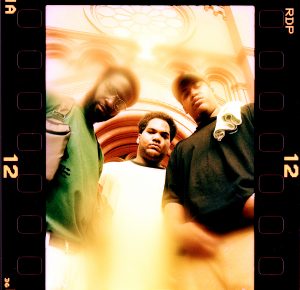
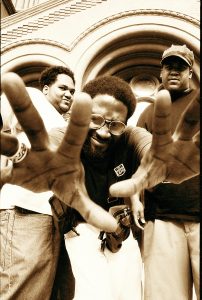
Walking onto the grounds of that Atlanta church to find Posdnuos, Maseo, and Trugoy the Dove was like stepping out of a storm and into a cathedral. The contrast was jarring. One hour I was navigating street politics; the next, I was looking through my lens at the soul of the movement.
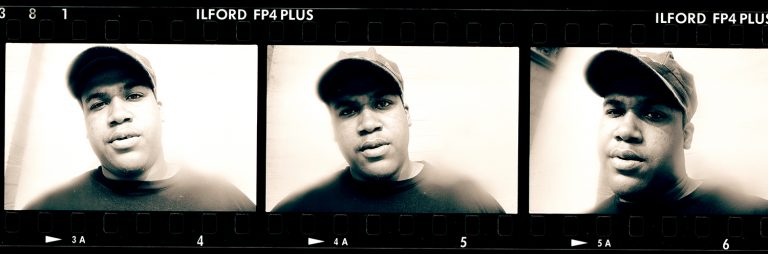
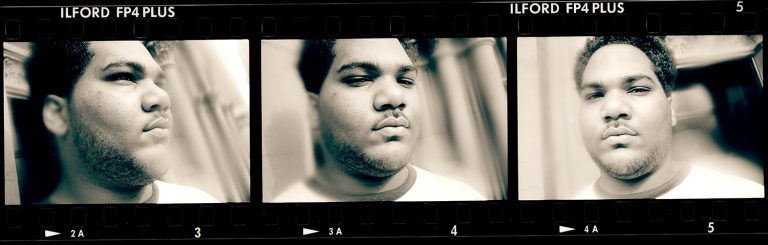
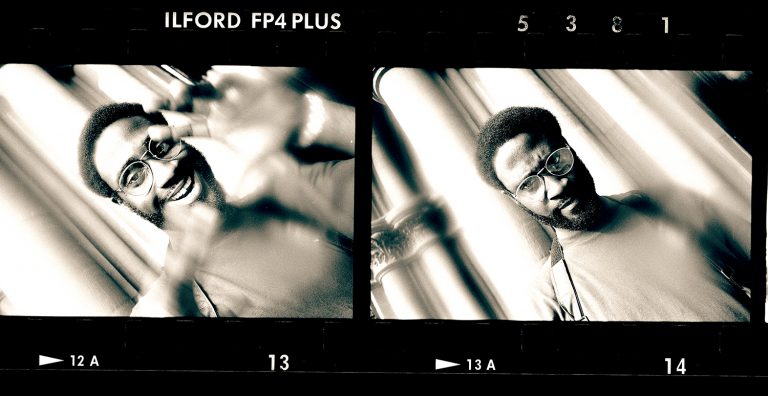
Looking back at these Ilford FP4 Plus and Fuji RDP strips, you can see that transition. There is a serenity in these shots that feels earned. De La Soul always represented the “Native Tongues” philosophy—intellect and a rejection of the caricature. Shooting them at a church for that editorial wasn’t just a stylistic choice; it was a reflection of the sanctuary their music provided from the chaos I had just left behind.
The Lens as a Bridge
In these frames, you see the tilt of the camera, the play of light against the stone arches, and the grounded, soulful expressions of the group. Seeing Trugoy (Dave Jolicoeur) in these photos now carries a different kind of weight. His passing left a massive hole in the hip-hop community—a loss that is still deeply felt by everyone who was touched by his humility and his pen.
These images serve as a time capsule of his light. The weight of that day—the “night and day” duality of violence and philosophy—is baked into every grain of the film.
That day didn’t just fulfill a magazine assignment; it ignited a career. By the time the sun went down, I witnessed a showcase by a new group called the Wu-Tang Clan that would change my life forever. But it was that afternoon—standing between the street unit and the sanctuary—where I realized my camera wasn’t just a tool for art. It was my protection, my passport, and my witness to the legend of 1993.