When you’re starting out, every opportunity to practice your craft matters—your framing, your lighting, your instincts. The more you shoot, the more range your portfolio has. And eventually, you start building a portfolio that actually speaks to being a working photographer.
This was still 1993. I only had a couple of album covers under my belt and a few magazine articles. But I was already meeting rappers, already outside, already in the mix.
One of those artists was a guy named Moore—M-O-O-R-E—who would later be known as Lord Have Mercy.
Lord Have Mercy was a deep thinker. A writer who spoke on politics, culture, and the streets—very vocal, very aware. Radical, but not in a negative sense. Radical in the sense of telling the truth. Coming off the early ’90s—after witnessing the beating of Rodney King, and police injustices happening in New York against Black communities—his energy reflected the moment.
He said, “Yo, let’s do some crazy pictures.”
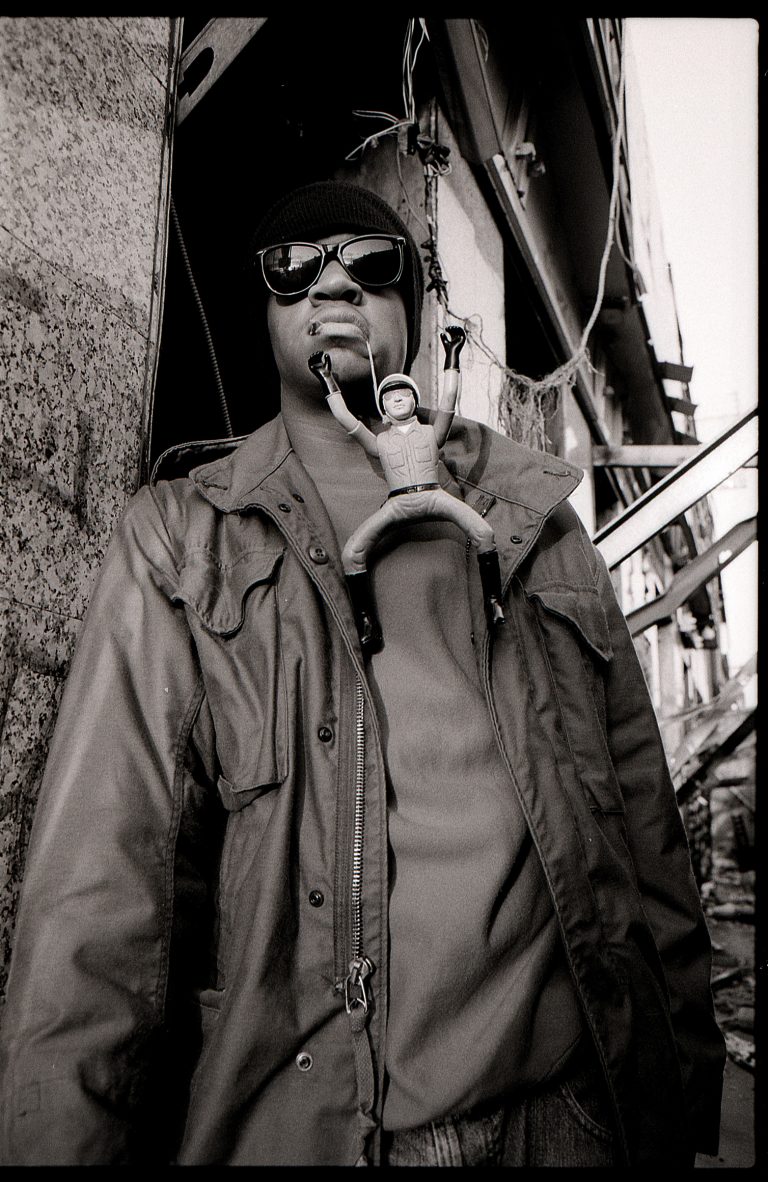
I’ll never forget it—he had a toy cop hanging from a string, and he was biting the string, almost like the figure was hanging by the neck. It was raw. Unfiltered. That was the contract you were signing with this book—no polish, no safety. Just truth.
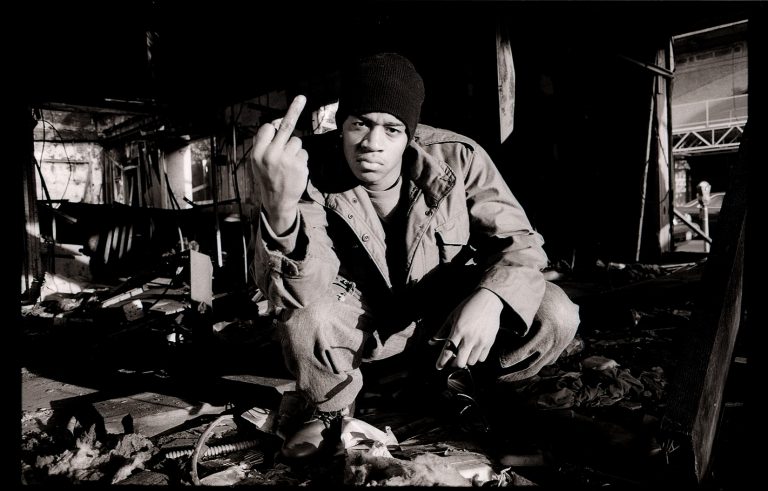
While driving through Queens, we came across a burned-out bar. From what I remember, it had been an arson—possibly a mob hit—and it was fresh. No barricades. No tape. I swear there was still smoke in the air. It had burned the day before.
We walked right in.
The ceiling was exposed. Exterior walls were gone—you could literally see across the street through parts of the building. And the light… the light was perfect. Late-afternoon winter light—low, thin, cutting through the darkness. It reminded me of the KRS-One train shots I’d done—where the sun is barely hanging on before sunset.
That kind of light lets you isolate your subject completely. Dark surroundings. A narrow beam. Total control. From there, it’s all framing. Angles. Coming down on your subject just right.